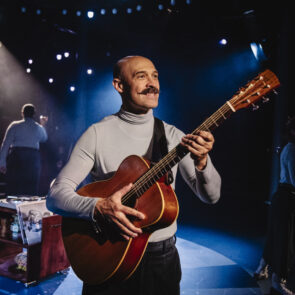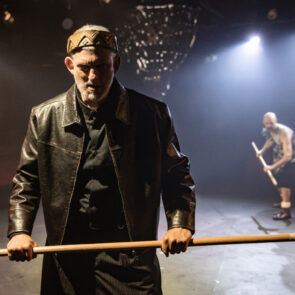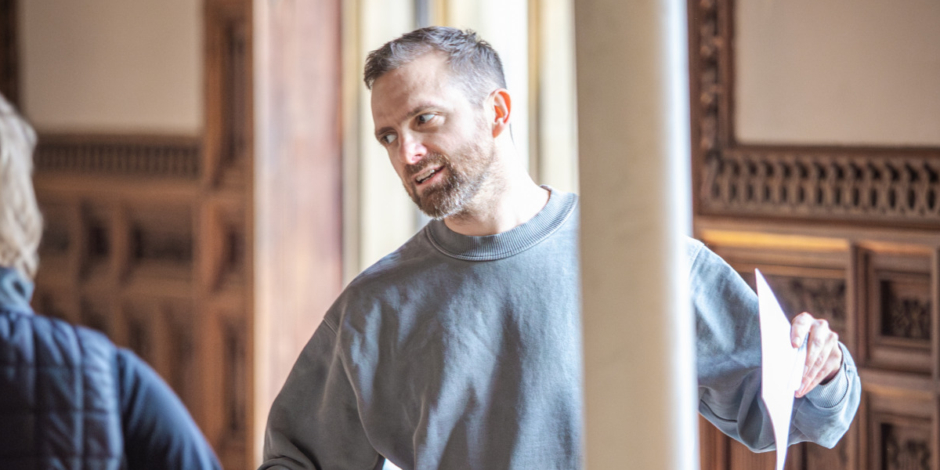
As rehearsals continue for Macbeth, we spoke with movement director Dan Canham about shaping the physical language of the production, and how movement is helping to uncover the violence, ritual and humanity at the heart of Shakespeare’s darkest tragedy.
What was it about this particular production of Macbeth that drew you to it and made you want to get involved?
The honest answer is that I’ve been working away from Bristol a lot — in London, Bradford, Sunderland, New York — and Bristol is my home. It’s a place I love working in, and Heidi is someone I’ve wanted to collaborate with for a long time. So when she asked me, it was an instant yes.
Then there’s the material itself. Shakespeare gives you such scope for grand, expansive emotions — emotions that can sit in the body. It gives you licence to be almost operatic in physical expression.
What I’ve discovered since being here is the absolute privilege of working with a cast of ten in that space — all of whom are incredibly skilled across so many elements of theatre. It’s a real joy.
Can you talk us through some of the inspiration behind the movement in this production?
What really interests me in Macbeth is the amount of violence — and the constant threat of violence — that sits alongside a very courtly, regal world of hierarchy and power.
A lot of my work lives in a ritual space, and that feels very relevant here. I’m interested in what it takes, physically, to transform oneself in order to enact violence — and then what happens afterwards, how that violence lives on in the body.
There’s also the idea of the “polite face”: the respectable, controlled exterior people present, and what sits underneath that — a kind of seething, animal energy that’s driving people towards terrible actions. That tension feels central to this play.
Is there anything different about movement-directing Shakespeare compared to more contemporary work?
I think Shakespeare gives you permission to go big — to lean into those heightened emotions. That doesn’t mean contemporary work can’t do that, but Shakespeare absolutely invites it.
At the same time, the challenge is that the words are so important. They are the primary driver of the story. So the question becomes: how do you create space for visual storytelling, movement, and subtext without crowding out the language?
Even when you’ve trimmed the text, we’re still very reverent towards Shakespeare. Finding that balance — serving the words while also offering a physical, theatrical language that the words alone can’t — is probably the biggest challenge.
Are there any sequences you’re particularly excited by, or nervous about, at this stage?
At this early stage, it feels like we’re being bold with the movement. Until things settle, it’s hard to know whether your instincts are completely right — but we’re diving in and committing.
The witches are a good example. We’ve developed a shared gestural, incantatory physical language for them that puts them into an altered state. It’s working well, but it’s always a knife-edge — close to cliché if you lose your nerve. That’s where trust in the performers and the strength of the material really matters.
When you’re working with something this iconic, you have to hold your nerve.
What can audiences expect from this production?
It feels rich. To use a cooking analogy, there’s a lot in the pot.
The depth of skill, experience and thought in the room means this work has been “cooking” long before rehearsals began — through people’s preparation, their personal connection to the material, and the groundwork Heidi has done.
I think audiences can expect something dense, layered and substantial — something that has been carefully and deeply made.
How do you approach movement direction when working with actors rather than trained dancers?
I didn’t train as a dancer myself, and I work a lot in community contexts, so whatever I do has to be owned fully by the people performing it.
I focus as much on intention, spirit and acting as I do on technical detail. The technicalities are only ever there to serve the storytelling.
The aim is that the movement allows performers to look like they’re in their power — not like they’re simply doing something they’ve been told to do. Different bodies may do it differently, but they’re united by a shared energy and intention.
Finally, without giving too much away, what would you say to audiences coming to see this Macbeth?
You probably haven’t seen a Macbeth quite like this.
In this space, the play feels like a pressure cooker — the intensity is heightened by the closeness of the audience and the performers. It feels immediate and charged.
It also speaks clearly to our time: a story about hunger for power, the lengths people will go to maintain status, and the cost of the violence that follows. But it isn’t black and white. There’s real humanity here — especially in the way the central character is approached.
That’s the tragedy. We can recognise ourselves in it. And that’s why we keep coming back to this play.
You can see Dan’s movement direction come to life in Macbeth at Tobacco Factory Theatres from 19th Feb – 28th March 2026.
Venue: Factory Theatre, Tobacco Factory Theatres
Tickets: From £15
Box Office: 0117 902 0344
Age recommendation: 12+
For full details on BSL-interpreted, captioned and relaxed performances, visit the Macbeth page on our website.
This production of Macbeth is proudly supported by Clifton College.

Posted on 29 January 2026