This year’s festive production, a Christmas Carol, is being written by a Bristol theatre legend – Carl Grose. As cosy season nears, we sat down with him for a chat about what we can expect from this years’ Christmas offering…
A Christmas Carol is a well-worn tale – but what feels fresh, or surprising about your adaptation?
Good question! I love the story. But there are so many versions of it around these days. I was was really keen that I offer something fresh, for myself as a writer and, more importantly, for audiences. So I had an idea of telling it from another point of view, namely that of my favourite characters, the three spirits! I felt there was more mileage to be found with this trio of ghosts. I wanted to see how they went about their supernatural business as they attempt to redeem Scrooge. I wanted to know how good they actually were! They then became key to how the show works theatrically… and, for fear of spoilers, I shall say no more!
What was it about A Christmas Carol that made you want to tackle it for TFT specifically?
Well, in seeking a way to present it anew, with a bunch of anarchic ghosts at its heart, it felt hugely liberating to write for the Tobacco Factory space because their Christmas shows are staged in-the-round. Meaning, the audience is all around the action. Imagining this story that way just brings a new kind of energy to the way I wrote it. You have to keep moving in that set-up, you can’t be static, and I love that about it. Also, you can’t get bogged down with loads of set. So the imagination becomes key to how you tell the story and how you stage it, and when an audience is asked to use their imagination, that’s when theatre gets really exciting for me. We’ve also set the story in “Dickensian Bristol”, which has all sorts of fun outcomes – who doesn’t love a local reference?
Jacob Marley feels much more central in your adaptation. What interested you about exploring him more deeply as a character?
Marley comes and goes in the original story, but again, as I developed the ghosts, I wondered if there was more mileage in having him in there more. But he had to have a strong dramatic purpose. One of the elements I found lacking dramatically from the story was a force of antagonism. What stops Scrooge (besides himself) and what gets in the way of our ghosts? We go along with it when we read the story, because we love watching Scrooge change. But again, how to make the show fresh? So you’ll find in my version that Marley has a very strong opinion about Scrooge. As the ghosts try and save his soul, Marley has other plans. I liked the idea that he wants Scrooge to suffer the same fate as he has. He also gets to ask the same question myself and the show’s directors asked ourselves, which is: why should Scrooge, of all people, get to be saved? That’s been fun to answer in the adaptation.
At its heart, why do you think A Christmas Carol still endures? What keeps pulling audiences back to it?
The best stories show how people change and I think A Christmas Carol is the ultimate story of change; from the world’s most mean and miserly man to an open-hearted, generous old fool. Scrooge’s change is joyous. Particularly at Christmas! And on that, it’s Dickens’ genius to combine Christmas with the supernatural. This is my favourite element of the story. Ghosts and Christmas strangely go so perfectly together, everything from BBC’s Ghost Stories for Christmas to A Nightmare Before Christmas. Why do we love it? Perhaps because deep down, we know the origins of Christmas are pagan. Ancient. It’s a time where the skin between worlds is thin. We can let it take us beyond the presents and the good cheer and put us closer to our older, more pagan selves. That’s why I love it anyway.
What’s the moment in the story you’re most excited for audiences to experience in the room?
When the three ghosts arrive. And Scrooge flying. And the ending. Oh, all of it, really!
TFT is such an intimate, in-the-round space. Has writing for this theatre changed the way you’ve approached the adaptation?
Yes, as I said earlier, the space married so beautifully with the idea of the trio of ghosts as stage managers. So while the idea of the ghosts came first, the fact that we’re in the round and surrounded on most sides by audiences is what really drove the writing. Drove it in a way that, if I were writing it for an end-on proscenium arch theatre, it wouldn’t have been half as exciting as it turned out!
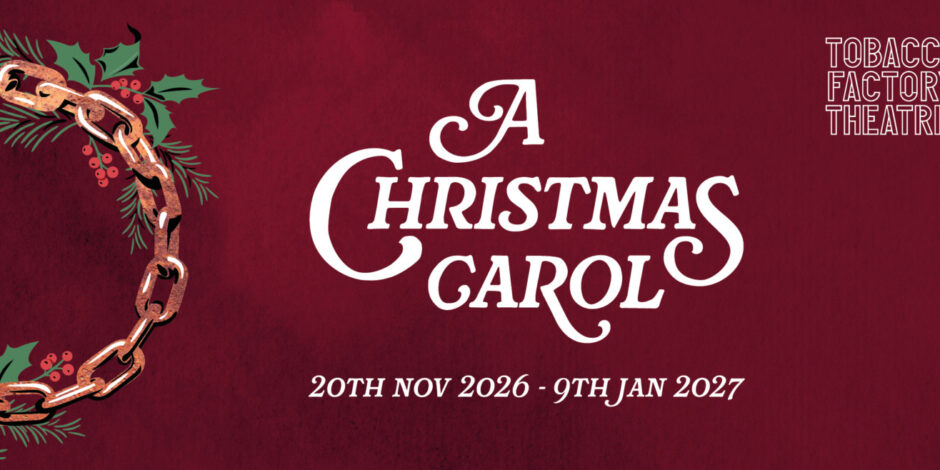
A Christmas Carol
Written by Carl Grose
Directed by Heidi Vaughan and Lydia Cook
🗓️ 20 Nov 2026 – 9 Jan 2027
🎟️ Tickets from £15
📍 Tobacco Factory Theatres, Raleigh Rd, BS3 1TF
If you want to get a taste of just the sort of heartfelt, mysterious and anarchic writing to expect from Carl, you can also catch his show, Widdershins, here at TFT on 12th September at 7:30pm in the Spielman Theatre.
Posted on 07 September 2026