Spend long enough around a troupe of Shakespearean actors, and you’ll notice something strange. Actors will happily rehearse murder. They’ll summon ghosts, conjure witches and plot regicide. But there’s one thing many of them still refuse to do inside a theatre: say the word “Macbeth.”
Instead, they call it “The Scottish Play.”
It might sound like a quirky theatre tradition, but the superstition has been around for centuries, and it all stems from Shakespeare’s darkest tragedy.
A play steeped in the supernatural
Even by Shakespeare’s standards, Macbeth is an eerie piece of storytelling.
Witches whisper prophecies. A ghost haunts a banquet. A king is murdered in his sleep. Ambition spirals into paranoia and bloodshed.
For audiences in 1606, these themes weren’t just dramatic – they were deeply relevant. England had recently gained a new king: James I, who had a very real fascination with witchcraft. It’s even been theorized that the play’s fascination with witchcraft was an attempt by Shakespeare to appeal to the King’s own dark fascinations.
Years earlier, while travelling by sea from Denmark with his new wife, the king had nearly been lost to violent storms. Convinced witches had conjured the tempest, he launched a series of witch trials in Scotland and later wrote his famous treaties on the supernatural: daemonologie.
So – when Shakespeare introduced three prophetic witches on stage, audiences were primed to believe something genuinely sinister might be at work.
When theatre folklore took hold
Somewhere along the way, stories began to circulate: Macbeth was unlucky.
Very unlucky.
One legend claims the actor playing Lady Macbeth died suddenly before the play’s first ever performance, forcing Shakespeare himself to step into the role. Other tales suggest actors were injured when real daggers were accidentally used on stage.
Over time, mishaps associated with productions of Macbeth became the stuff of theatre folklore.
Perhaps the most infamous example happened in New York in 1849, when rival supporters of two actors performing the role of Macbeth – Edwin Forrest and William Macready – clashed in what became known as the Astor Place Riot, leaving more than twenty people dead.
Even the great Laurence Olivier had a close call during a 1937 production at the Old Vic, when a heavy stage weight reportedly crashed down from above, narrowly missing him.
Coincidence? Possibly.
But the stories stuck.
When saying “Macbeth” meant bad news
There may also be a more practical explanation behind the superstition.
Historically, Macbeth was sometimes viewed as unlucky by theatre companies because announcing a production of the play could signal financial trouble.
As theatre historian Martin Harrison notes in The Language of Theatre (1998), the play was often chosen because it was reliably popular and likely to bring audiences in when a theatre needed a box office boost.
Ironically, the very thing that made the play attractive could also be risky: Macbeth can be an expensive production to stage, with large casts, elaborate effects and dramatic set pieces.
For struggling theatres, it was sometimes a gamble, but one which could pay dividends.
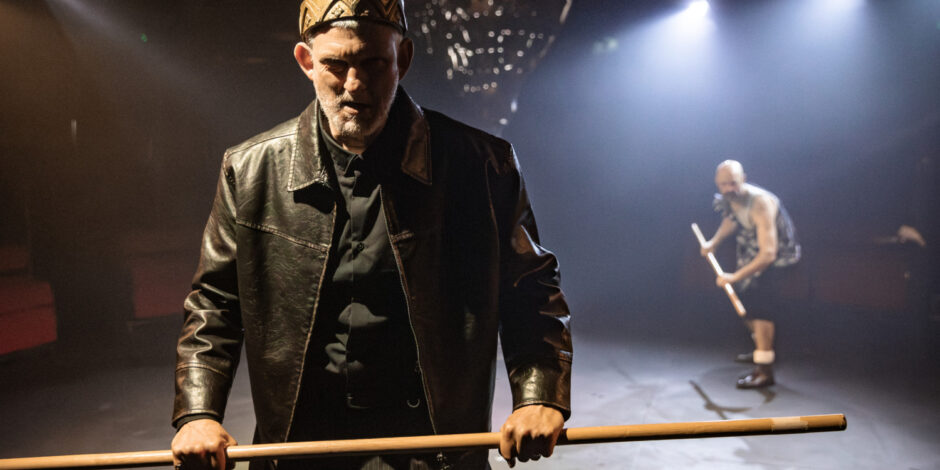
(Just to be clear — we promise this isn’t why we’re staging it!!)
The curse strikes again
The legend of the curse has been kept alive by countless theatrical mishaps over the years.
One of the most famous happened at Stratford in 1948. Actor Diana Wynyard, playing Lady Macbeth, had told a reporter the night before that she thought the curse was ridiculous.
The following evening, during the sleepwalking scene – which she performed with her eyes closed – she accidentally walked straight off the edge of the stage.
She fell fifteen feet into the orchestra pit.
Thankfully, she escaped unhurt. But the timing did little to reassure believers in the curse.
The rule every actor learns
And so a tradition was born.
Inside a theatre, the play’s name should never be spoken aloud unless you are rehearsing or performing it.
Break the rule and you’re expected to follow the ritual: leave the theatre, spin around three times, spit, swear loudly, and knock to be let back in.
The logic may be questionable, but the superstition persists. Theatre people, after all, are nothing if not creatures of tradition.
The play that still haunts audiences
Whether cursed or not, Macbeth has lost none of its power.
Its witches, prophecies and spiralling ambition still grip audiences more than four hundred years after it was first written. The story moves quickly, the stakes are high, and the atmosphere is thick with tension from the very first line.
Which may explain why theatres keep returning to it.
And why, backstage, you’ll still hear people carefully referring to it as “The Scottish Play.”
Just in case.
Posted on 16 March 2026